I’m an Assistant Professor of Physics at Texas A&M University, working on experimental neutrino physics and its related problems. My group works on DUNE, SBND, and CCM, developing the simulation, machine learning, and statistical tools that let these detectors see beyond what they were designed for.
Highlights
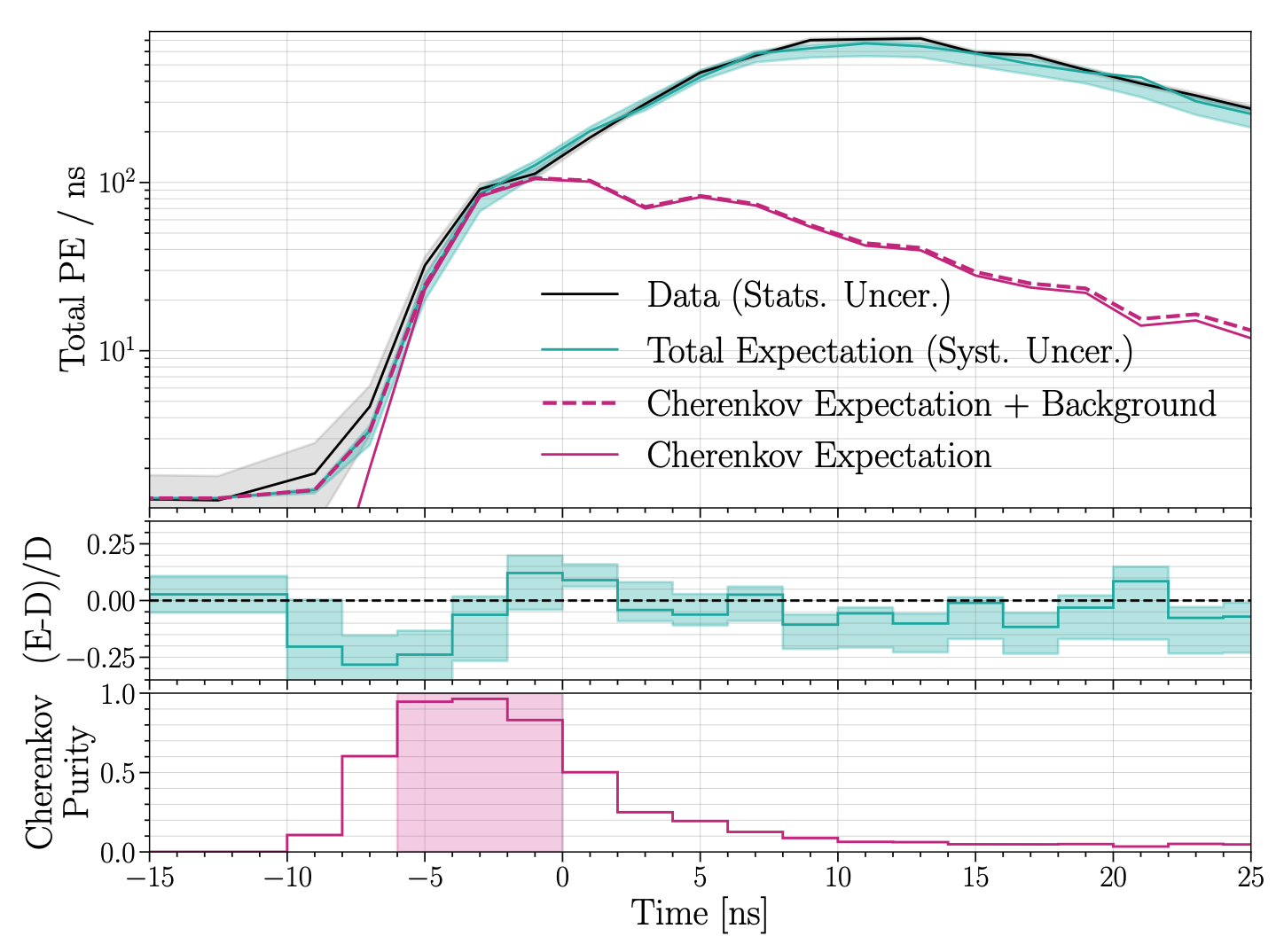
Liquid argon detectors record far more information than standard event reconstructions can take advantage of, but this information can be used to lower the energy threshold of detectors, improve particle identification, and generally help us learn more from each interaction. Accomplishing this requires accurate detailed modeling of the interactions and detector response, in addition to sophisticated machine learning reconstruction methods. We have built and continue to develop the machine learning and differentiable programming methods that produce these advances. Recent results include the first event-by-event identification of Cherenkov light from sub-MeV particles in liquid argon Phys. Rev. Lett. 135, 171804 (2025) and a liquid argon calibration measurement using a fully differentiable simulation Phys. Rev. D 112, 072010 (2025). The payoff is MeV-scale supernova, solar, and dark matter physics in detectors built for GeV neutrinos.
The Deep Underground Neutrino Experiment (DUNE) will be the largest liquid argon detector ever built, and the best thing about it is its range: the same detector that records multi-GeV beam neutrinos can study atmospheric muons at hundreds of GeV and supernova neutrinos at a few MeV. My group works on the low-energy end of that range, developing advanced machine learning reconstruction techniques to lower DUNE’s energy threshold and expand what we can learn from low-energy interactions.
Past contributions to DUNE include phenomenology at high energy (~ 500 GeV) and low energy (~ 5 MeV) scales. Phys. Rev. D 104, 092015 explores DUNE’s high energy sensitivity to BSM scenarios with atmospheric neutrinos, and Phys. Rev. D 108, 043005 investigates DUNE’s sensitivity to the NuX component of galactic supernova neutrinos.
At the intensity frontier we search for extremely rare interactions from a wide array of models. Not only is it challenging to test all of them, but a discovery of new physics will require validation across many experiments. SIREN is an open-source injection and weighting framework that makes it easy to inject new BSM scenarios across many experiments. It efficiently simulates rare processes in any detector geometry, and is compatible with a wide range of BSM models and rare SM processes.
Recent SIREN releases add support for a wider range of detectors, native GDML import, integration with the DarkNews and Marley generators, and export to the NuHepMC3 format.
SIREN Paper: Comput. Phys. Commun. 316, 109799 (2025).
GitHub Repository: https://github.com/Harvard-Neutrino/SIREN
CCM is a liquid argon detector operated at the stopped-pion source at Los Alamos National Laboratory, built to detect neutrinos, dark matter, axion-like particles, and anything else that couples to photons or mesons. The experiment recently completed its run; I coordinate its analysis effort as we work through the full dataset. Critically, CCM will measure the electron neutrino charged current cross section on Argon at the 10’s of MeV scale, which is critical for DUNE supernova observations.
Themes of my work in BSM physics
Collaboration between theorists and experimentalists is of the utmost importance in our field. Strengthening these connections helps us to produce higher quality studies and model tests, build better targeted experiments, and advance the field more quickly. In my work I have maintain strong connections theorists, collaborating on phenomenological analyses, organizing better data releases, and directly involved them in experimental collaborations.
While much of US particle physics funding is focused on large projects, small scale experiments have an important place in the training of early career scientists and in maintaining the agility of our research programs. In a 2023 P5 townhall, I outline the benefits of small scale experiments and argue for their support from US funding agencies. A copy of this short talk can be found here.
We have strong reason to believe there is as of yet unexplained BSM physics, and many observations point to the neutrino sector as a good place to look. I gave a colloquium at MIT-LNS that explores recent thinking on BSM neutrino physics and ways in which we can make connections across a wide range of observable energies. A full copy the talk can be found here. I also covered searches in 100 keV to 100 MeV energy range in a session on BSM connections across the energy scale at the April 2023 APS meeting, a copy of which can be found here.